Candid Conversations with Digital Health Innovators & Business Leaders
Welcome to the Breaking Health Podcast
Conversations between VCs and entrepreneurs typically occur in boardrooms or coffee shops. In the Breaking Health Podcast, you get a seat at the table. Our hosts bring their investor insight to revealing conversations with the most disruptive CEOs in healthcare. Listen to understand how these leaders are building the companies – and fostering the cultures – that will change everything.
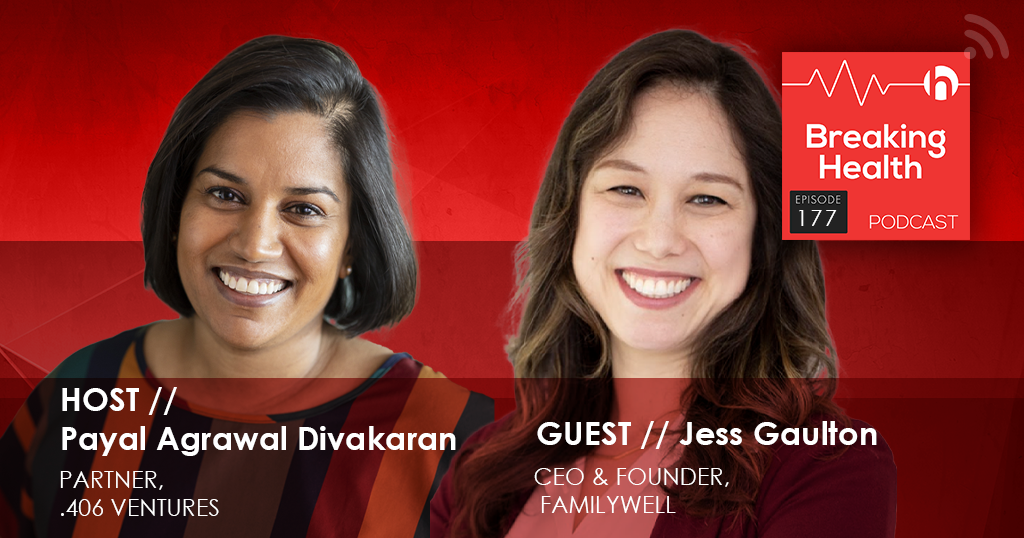
Jess Gaulton, CEO and founder of FamilyWell, has created a space where women can find care for their mental health during their reproductive journey, including for post-partum depression. In this episode of Breaking Health, hosted by Payal Agrawal Divakaran, Gaulton discusses why her company is also focused on menopause, how they're making their resources accessible and affordable, and why OB-GYN's are so willing to send patients to FamilyWell. Plus, Gaulton shares what inspired her to go from practicing medicine to entrepreneurship, her venture capital experiences, and the best and worst parts of being a founder.
GUEST BIO
Jess Gaulton, M.D., MPH, CEO and Founder, FamilyWell
Dr. Jessica Gaulton is a physician-entrepreneur whose expertise lies at the intersection of maternal and newborn health and healthcare innovation. She is a practicing neonatologist at Harvard and founder and CEO of FamilyWell Health. FamilyWell’s mission is to provide high-quality, equitable, and affordable access to integrated mental health services for women throughout their reproductive journeys. Dr. Gaulton received specialized training in innovation and design at the Penn Medicine Center for Health Care Innovation; clinical fellowship in neonatology at the Children's Hospital of Philadelphia/Penn Medicine; medical degree from the Johns Hopkins School of Medicine; a master’s degree in public health in health policy and management from the Harvard School of Public Health; and pediatric residency at the Boston Combined Residency Program at Boston Children's Hospital/Harvard Medical School.
MODERATOR BIO
Payal Agrawal Divakaran, Partner, .406 Ventures
Payal is a partner at .406 Ventures, where she co-leads the healthcare investing practice. .406 Ventures is a Boston-based venture capital firm with over $1.4 billion under management. Since its founding in 2005, .406 Ventures has never wavered from its strategy of investing in early-stage enterprise-focused startups in healthcare, data + AI, and cybersecurity. Every member of the firm has deep operating or investing experience in these segments. .406’s world-class founders and digital health companies are transforming healthcare technology and care delivery. Payal leads .406’s investments in AristaMD, Diana Health, Equip, FamilyWell, Heartbeat Health, Humata Health, Nema Health, Nomad Health, OncoveryCare, and Wellist. She also supports Better Life Partners, Laudio, Redox, Wayspring, and WelbeHealth.
Before joining .406 in 2015, Payal co-founded a company called SpotRocket while at Harvard Business School (HBS). Prior to that, she worked at Eventbrite, Spectrum Equity, and J.P. Morgan. Payal received her MBA, with Distinction, from HBS and her bachelor’s in electrical engineering and minor in management from MIT. She is a Boston native and Boston sports fan. She, her husband, and two kids live in Brookline.
TRANSCRIPT
Announcer:Welcome to the Breaking Health Podcast, a series of discussions with the most disruptive CEOs and leaders in digital health.
Payal Agrawal Divakaran:Welcome to the Breaking Health Podcast. I'm your guest host, Payal Agrawal Divakaran, and I'm thrilled to be joined by Dr. Jess Galton, founder and CEO at Family Well. Jess, welcome.
Jess Gaulton:Thank you so much for having me, Payal. This is really exciting. This has been something I've been looking forward to over the holidays.
Payal Agrawal Divakaran:So And it's the new year, the first podcast of the year. And I think it's fitting to be talking about mental health and women's health, two areas where AI is not the panacea. So I'm particularly excited to be talking about Family Well. So for the listeners, tell us what Family Well does.
Jess Gaulton:Awesome. Well, Family Well is a women's mental health company. We are partially virtual, but we deliver services to women across, you know, their anytime in their reproductive life cycle when they're struggling with a mood disorder. We started in maternal mental health or perinatal mental health, mostly because of my own background as a neonatologist and as a patient myself, and really focused on getting creating, really pioneering a new model of care that integrates into the existing healthcare system. So much of what we do or the resources that are available to women, although limited, exists outside of the healthcare system right now. It's so hard to access, it's costly, and it's not covered by insurance. And so, Family Well integrates those really life-saving mental health services directly into the healthcare system, making it making it accessible, affordable, and covered by insurance.
Payal Agrawal Divakaran:And if I'm a patient looking for your services, what's the best way to access that?
Jess Gaulton:Yeah, so right now you can access us through your OB-GYN provider. We're currently in operating in five states and we partner directly with clinics and health systems. And so right now, the way that you would get to us is through a referral from your OB-GYN provider. A referral, though, doesn't mean it's not the traditional sort of referral out into the community. What we try to do is think about us as a refer, a referral in, right? We're inside of the clinic. We embed ourselves into the clinic. We provide virtual coaching, therapy, psychiatry for med management, and care coordination services so that it's easy and it's right, we're meeting the patients right where they are when they need us. And so, it's accessible right there when you get pregnant. Your OB-GYN provider can refer to Family Well. And we're part of the team. We're part of your medical team.
Payal Agrawal Divakaran:Yeah. And you talked about, you know, referral out versus referral not out. So let's talk about that a little bit more because it's you're it's always hard to get providers to send a patient elsewhere. Why are OB-GYNs motivated to sell send patients to Family Well? What code have you cracked there?
Jess Gaulton:Yeah. So traditionally, what OB-GYN providers typically do, and and any providers on the ground, like for my, for example, myself, I'm a neonatologist. So I'm a board-certified pediatrician and then specialized in babies and specifically babies in the NICU. And so I'll just give you an example of my own experience as a physician to highlight what the existing healthcare system, how it currently operates and the aspects of it that are particularly broken. So for example, I would take care of families right in the NICU and I would see them in clinic after the baby was discharged from the NICU, from the ICU and or the neonatal ICU in types of care unit. And so I would see the parents in clinic. And when I saw a mom struggling, especially during COVID, where people were really in crisis, right? So so much more so than even, you know, before, before that, so many moms are struggling. They would come into the office, they would, they would be crying, and the babies are fine, the babies are healthy, but they are really struggling with their mental health.
Jess Gaulton:And so as a provider, what I had at my fingertips was a list of therapists on a piece of paper that hadn't been updated since the 1980s. And I would give the mom a hug, hand her the paper, and she would, and I would say, good luck, right? Like, here's a list of therapists, go figure it out yourself and see if call them, see if they're covered by your insurance, see if they have availability. As a provider doing this myself, I felt icky. This, this wasn't this to me wasn't the right way to treat these women. First of all, not all women want to start with a therapist. If they've never had an encounter with or problem with their mental health before, saying, Oh, here's a therapist, here's a list of therapists, go figure this out is like absolutely the wrong approach. So a lot of women don't want to start with a therapist. They really need to talk to somebody who understands what they're going through, right? And what I felt like was missing was that was that let's figure out, let's like actually have some empathy and let's talk and let's figure out what you need and let's get you access so that you it all of the weight of the problem and the logistics of figuring out how you're gonna get care is not on you because you're struggling. You have a new baby. Let's take that off of your shoulders, let's put it on Family Well and let's figure this out for you and make sure it's accessible immediately and covered by your insurance.
Jess Gaulton:So, previous to Family Well, we would give people a list of therapists and send them out to the community and have no further contact with them about their mental health. Now with Family Well, what we do is we partner directly with the clinics or the health systems. Your OB-GYN provider or and eventually hopefully all providers will be able to say, Oh, well, we have this amazing partner, Family Well, in our clinic. It sounds like you're struggling with some symptoms of anxiety or depression. Is it okay if Family Well reaches out? We reach out to you within 24 hours. We offer you a conversation with a coach within 24 hours to really explain what we do and what our program is. And then every patient that enters our program gets a multidisciplinary team of providers, includes a virtual coach, a therapist, a psychiatrist, and a care coordinator, a care advocate, really, that you can text on demand. And so you have all these people at your fingertips. It's there for you immediately within 24 hours, and you get it covered by your insurance. And so let's let's take the burden of like figuring this out off of the patient, put it on the healthcare system, put it on us, and let's give them access to really high quality care quickly.
Payal Agrawal Divakaran:Yeah. And I think that covered by insurance piece is a critical one because when 406 was looking at investing into FamilyWell and your seed round, I think one of the things that we're maniacal about is the incentives, right? You talked about the provider incentive, but what is the payer incentive? And, you know, oftentimes in mental health care, it's actually when you cover something, there's just higher utilization for no outcomes. But in this instance, I think there's a belief that there are better outcomes for this treatment. And so the health plans have sort of reimbursed it. There's the collaborative care model and so on. And so we're, I want to talk about the outcomes in a second, but you mentioned the care team and it's sort of differentiated to have a multidisciplinary care team, though a common theme within the 406 portfolio, because I think we really believe in that and the mental health. And you talked about sort of not needing the therapist right away. But you're doing something different as it pertains to these coaches. So let's talk about that, how you're bringing them into the system. Tell us a little bit about the coaches and the certification and so on.
Jess Gaulton:Yeah, absolutely. So the coaches are the foundation, coaching itself is the foundation of our model. What I felt like was missing as both as a patient myself and a provider is is truly just empathy. You know, you go into the system as a patient and you're you're you're scared. And this is this is across the board in in healthcare, right? Like you're you're scared, you don't know what to expect, you just want someone to tell you that, like, hey, I've been there, I've done this, and you're gonna be okay. And this is what you need to expect, right? And and I'm gonna give you some really tangible ways to get through your day. And I'm gonna be your cheerleader and advocate through this. And so, what I felt like was missing with women's mental health as a whole was that empathy piece. And how do we create empathy and how do we make it a really positive experience? And that is truly through peer support and coaching. Now, peer support has been around in, you know, the perinatal mental health or maternal mental health field for a really long time. But I felt like what was missing was really elevating peer support to an actual therapeutic intervention that can be replicated, where we can train people to deliver evidence-based techniques and actually be effective at treating patients, right? And and that also goes hand in hand with the mental health provider shortage, right? There are not enough therapists and psychiatrists to treat the patients who need them. And there are a lot of patients that are referred to therapists and psychiatrists who really could benefit more from coaching primarily, than going and seeing a therapist.
Jess Gaulton:Like the very mild, for example, me. I had had initially had mild anxiety, mild modern anxiety when I was going through this myself. I started having intrusive thoughts, which are like scary thoughts that pop into your head, that, you know, mine, for example, was accidentally dropping my baby down the stairs. And I would have these really intense thoughts throughout the day. And I didn't know what they were. And so I got really anxious about them. And then because I didn't know what they were, even as a provider, we don't get training in this, I that sort of spiraled into a depression. And so if we could have caught that earlier, and I could have gotten some coaching and some and learned that these are called intrusive thoughts, they're a real thing, everybody has them, it's okay, right? If we can catch people earlier, treat them with evidence-based techniques that can be delivered by coaches, we can prevent a lot of the downstream morbidities, right?
Jess Gaulton:We can prevent people from needing medication, we can prevent people from needing long-term therapy or inpatient stays, or, you know, so so that's the idea behind the coaching is to elevate from peer support to coaching as a therapeutic intervention and how do we train people to do that? The training certification program didn't exist. I try I took all of the courses out there myself. It just didn't exist. So we had to build it. So we built a Family Well's Perinatal Behavioral Health Coach certification program. It's for non-licensed individuals who want to coach as their profession. And so we put this out to the public last year. It's a subscription service. We want people to take it, even if you don't aspire to work at Family Well, we want to train a workforce of coaches who can go out and really help women in this space. And so our 75% of the care that we deliver is actually delivered by coaches. And we reserve, strategically reserve the therapy and the psych services that are much harder to access at much more costly. And for the highest acuity patients in our program.
Payal Agrawal Divakaran:And you and I, I remember connected on the personal experience of, you know, sort of the postpartum depression that we both experienced, which I had after my second child. And I think going through that experience informs so much of what the need was for Family Well. Because at that point, I was grateful to, you know, a company called Able to in our portfolio that really helped me through that moment. And then, but seeing sort of where the gaps were and the opportunity was for specific care, I think was, you know, I think you and I were both informed by the personal experience.
Jess Gaulton:Yeah. If it's okay, I'd love to double-click on that because that's such an incredibly important point, is that, you know, you and I both got treatment that wasn't specialized in perinatal mental health at the time. It it may not have really existed at the time, to be honest. And might have been, it was so hard. You know, you and I are both very, you know, I'm a physician. I trained at the best institutions. You went to MIT. We had we had so much privilege in our lives to be connected to all these great people. And yet we didn't find specialized treatment for us for what we were going through, right? And and so I saw a therapist who was not specialized in perinatal mental health. And yes, it was helpful to some extent, but knowing what I know now, all of our coaches are therapists or psychiatrists, their entire focus in their career is women, right? And specifically women going through what we went through. And so I think that specialization is incredibly important.
Payal Agrawal Divakaran:Yeah. And now you've embarked on, you know, perimenopause. And we're gonna get to that in a second, which is gonna help us in our next, you know, leg of our our journey in our lives, you're in mine, but we're gonna let's put a pin in that one and come to you because I I think the listeners are gonna be so excited to learn about you know your journey and some of the things that you mentioned. So you were a practicing physician here in Boston, you know, like you said, some of the best institutions in healthcare. And you turned to an entrepreneur. How did you make that decision? How did you cross that chasm?
Jess Gaulton:Yeah, it's a great question that I'm trying to figure out still to I think I'll just go way, way, way, way back in time, right? So, I am somebody who grew up in a biracial household. I'm half Jewish and half Buddhist. And my dad is or now is retired, but was an international journalist. And so we traveled the world and saw, saw a lot of, I had a lot of exposure to the world early on. And I had the opportunity to see how different cultures do things differently, different communities do things differently. I saw a wide spectrum of, you know, I saw poverty at a very young age where a lot of people don't have that opportunity. And so I've always grown up with this mindset of like, is there a way to do it differently, right? Or do you do it in a creative way, put things together in a way that haven't been put together before? And so I'll give you an example of my first entrepreneurial endeavor at home in the growing up. I think I was maybe five or six. So I took all of the books in our house that we already owned and created a library and cataloged them, put price tags on them, and then I charged my parents to buy books from my my bookstore.
Jess Gaulton:And they're like, wait a second, these are our books. Like, why do I have to pay you to buy a book from your bookstore? It just shows you that, you know, from a very young age, I think I had all the inputs and part of me, I was just built to sort of be an entrepreneur at an early age, but didn't recognize it until I was much older. So that's sort of the early, early part of my life. And then, you know, I became inspired through many experiences to become a physician. And I love taking care of families and babies. So I trained through the normal academic route to do that. You know, I was pre I was so fortunate to be able to train at Harvard, Hopkins and Penn. And I'm still a practicing physician. I'm still a neonatologist at Harvard, one of the Harvard hospitals. And, and throughout my time as an academic physician, I always was the one who raised my hand and I said, Well, why can't we do it this way? And, you know, at every institution, they're like, well, just that's the Harvard way, or just that's the Hopkins way, or just that's the and so I was always the troublemaker.
Jess Gaulton:And I never felt like I fit into that academic box. And so now that now that I, you know, experienced my own mental health struggles and have experienced what it feels like to be a provider taking care of patients who are experiencing that same struggles and thinking about how can we do this differently and better. This was the perfect opportunity and a culmination of my passion, of my professional background, of my training to be able to make a difference. Because women's mental health is broken. There's not enough investment, there's not enough training and focus, there's just not enough attention. And I'm so grateful for you and .406 for seeing this opportunity because we have an incredible opportunity to fix the system right now. And I think we're we're we're starting on that path and we're already making a difference. And so I want to go back because I I want to go back to really what our mission is at Family Well. It's to increase access to affordable, equitable, and high-quality mental health care for women. And, you know, I mentioned we started in maternal mental health, and then you alluded to us expanding out to perimenopause and menopause.
Jess Gaulton:And, what we what we want to do is make sure that women get the focus and attention when they're struggling with mental health conditions that they deserve. And just to give you a couple of really sobering statistics, so one in three women, up to one in three women are diagnosed with postpartum depression. 80% of women aren't unable to get treatment, access treatment for a number of reasons, right? And the number one cause of pregnancy-related death is from suicide or overdose. So we've all heard about conditions like preeclampsia, you know, hypertension. We've heard about all these medical conditions, right? Suicide and overdose trumps those conditions. More women die from those conditions, from mental health conditions than they do from medical conditions in our country. And that's very much an outlier compared to other developed countries in the world. Yeah.
Payal Agrawal Divakaran:And I'll just underscore, you know, what you mentioned about your journey. I think from my perspective, and certainly the four of six experience, there are certain physicians who thrive within the walls of these institutions. And, you know, that's their calling. You know, my husband, I think, is one of them. My husband too. Yeah, we have also have that in common. But then there's ones who just need to break out of those walls, and to your point, are dreaming about things that have to be done differently and can't be done within those constraints. And I completely echo that you are one of them. And I think the moment that you got out, you sort of, there was just, you know, the wings and you could fly. And that's, you know, I think that's what we saw. But when we did talk about fundraising, we'll shift to the fundraising topic. You know, I think there was this question of do you sort of take venture capital money or do you bootstrap it? You know, we sort of, I remember talking about that topic and you sort of thinking through that. So what tilted the scales towards let's raise the venture capital and go forth?
Jess Gaulton:It was you. It was you and 406, truly. Because I was so determined. I was I had bootstrapped it for about two years, right? I'd raised a little more. I did not expect that answer.
Announcer:Thank you.
Jess Gaulton:It truly was. I had raised a little over a million dollars. And I wasn't at the time I wasn't paying myself. I was still working 100% clinically to be able to pay my team salaries. And I was raising some more angel capital. And so it you happened to fortunately came to one of my pitch dinners with angel investors. And, so we started talking and and I really wasn't thinking about going the venture route. And I remember distinctly this conversation you, Liam and I had. I think it was at one of, I think it might have been at BHC or what behavioral halls tech conference, maybe two years, two or three years ago. And, you and Liam sat me down and basically said, Hey Jess, what is your vision? Do you want this to be a small regional, basically multi center clinic, which is essentially it's it's true. Like that's what that oftentimes with you know a couple million, that's the scale that you can get to, you know, within within a couple of years, right? And so you it you guys sat me down and you said, what is your vision? Do you want this to be a huge thing that everyone can access? Or do you want this to, you know, grow slowly and then maybe someday be a big thing? And I had to go home and I had to really gut check and think about what I wanted for me, my career, my family.
Jess Gaulton:And I came back to you and I said, I want this to be a big thing. I want to change the world. And and and going back to my roots, like that's sort of how I'm built, right? I've always wanted to change the world. I've always wanted to make it better. And so I said, you know, I want to, from the ground up, revolutionize women's mental health in our country. And this is, and I don't want to just do it in one state. I want to do it everywhere. So of course, we you have to take that in a staged approach, right? Like we're not going to go to all 50 states in one year, but the vision is that we're we're, I want every single family in this country to have access to family will. And you're gonna get there.
Announcer:Are you enjoying the conversation? We'd love to hear from you. Please subscribe to the podcast and give us a rating. It helps other people find and join the conversation. If you've got speaker or topic ideas, we'd love to hear those too. You can send them in a podcast review.
Payal Agrawal Divakaran:And you got, you know, you got part way there through the the seed round that we were so fortunate to lead. And then what I loved about what happened post-seed round was that even though you have this big change the world vision, you sort of you you zoomed back into the micro. And maybe this goes back to you labeling the books and selling them and the economic, you know, mindset, but you were really focused on the fundamentals of the economics and how you know we make this work. And I remember, you know, there one board meeting where we sat and we said, okay, looking at this economic profile, we've got to focus on gross margin. And then it was like the next two quarters was just like the just, you know, gross margin focus show. And you did it and you focused on those fundamentals. And that's honestly, it was it was that focus on the fundamentals that allowed you to raise the series A last year. So you raised an $8 million series A in one of the hardest fundraising environments where it was all about AI and nothing else. And, you know, I think I was just extremely proud, not surprised, and extremely proud about that. And so, having seen that experience, what do you think it was that got you over that finish line? And what advice would you give to founders who are, you know, giving their 30th or 40th pitch this week?
Jess Gaulton:Yeah, well, thank you so much for for that. It it was you were right there beside me the whole time and it was it was tough. It the outcome was incredibly rewarding. And I think first I just want to pause and just give it's not the just show, it's a team effort. And like I'm fortunate to be the face of the company. But the reason why we got our gross margins to where they are now, the reason why we were able to pioneer a new, you know, care delivery model for women is because of the team and because of the passion of our team. So our team, I just want to tell you a little bit about our team. I'm so proud of them. They are almost all women. Not that you have to be a woman to work a family. Well, you truly don't. We have men, but we women gravitate toward our team because almost everyone on my team has has some sort of lived experience with an emotional struggle, right? Like whether it was during pregnancy, postpartum, menopause, or some other phase in your life.
Jess Gaulton:And so we have attracted these incredibly passionate women who have who are all unicorns, to be to be honest, you know, and it's because of them that we were able to achieve what we've achieved so far. So I just want to say that. And then to the entrepreneurs out there who are like, do I start a company? Do I raise? I think if you wake up not like if you wake up every morning and you're not able to shut your brain off, and you absolutely have to solve a problem that is so burning that it's what you think about when you wake up and it's what you think about when you go to bed, you you have to go and try. You have to go and do it. And the odds are against you, unfortunately, in this, you know, in the in a male-dominated venture capital world. But, you know, if you have the passion, the drive and persistence, then I think you can do it. I know you can do it. And so to the entrepreneurs out there who who want to make a difference, like go and do it, right? There's so many problems to solve. And if you have one that's so burning that you can't let let go of it and you can't focus in your day day job, then go for it, right?
Payal Agrawal Divakaran:Yeah. Yeah. The, you know, I like to say, you know, great companies always get funded. And the foundation of a great company is, you know, it's often the, of course, the passionate founder, but it's that idea that stems from something that what you're talking about, this burning, you know, lived experience or desire. I think the ones that are often challenged are the ones that sort of say, you know, I know I'm a great operator, executor. Let me just figure out an idea and go for it. It's sort of there's just so many elements of this journey that require you to run through walls where the idea has got to be something deeper than that.
Jess Gaulton:Yeah, I completely agree.
Payal Agrawal Divakaran:Right. So I think the, and and by the way, the Series A was led by an amazing firm called New Markets Venture Partners. A nd we were we were thrilled, .406 was thrilled to get to know them as well because they have this understanding of of education as well as healthcare. And so they really gravitated towards, you know, this coaching certification model and your vision to sort of train, you know, the world's coaches. So I really love that. And you've had some, you know, mother ventures and gray matter and other folks who are really mission aligned along the way. So just like you described the team, I agree. There's this gravitation towards the mission. I think your investors, there's a gravitation towards them the mission. How did you go about selecting? You know, maybe listeners always ask about this, your venture folks. You know, what are some advice around selecting those, those you chose to add to the board? You know, you've got Dr. Neil Shaw on the board, you've just added another great operator to the board. You know, how do you think about who you surround yourself with?
Jess Gaulton:Yeah, I love that question. Some of it is truly luck. Like if I didn't live in Boston and and didn't train where I trained and had all of the privileges and, you know, that I have, as a physician, like I don't know if I would have met you, right? So I have to acknowledge that some of it is is luck. A lot of it is hard work and networking and the people that I've been very fortunate to have around the table right now are people who number one, first and foremost, share the mission and the vision. And I'm really lucky that our investors right now all share that mission and vision and are so passionate about this space that we're in. And so I think that's number one. And then also having diverse perspectives. Like you said, you know, New Markets Venture Partners, I love that they are ed tech investors traditionally. And I'm, you know, they've recently started investing in mental health and healthcare, but they bring this like unique perspective that if we surrounded or if I surrounded myself with all healthcare investors in Boston, we would have one perspective, right? It's like, so we want, I want diverse ideas, I want diverse perspectives. And then a mix of clinical and operators, like everybody has their own sort of experiences and that that add color to the decisions that we make as a company. So, you know, your perspective as an investor and an engineer, and then Dr. Neil Shaw's perspective as a physician and CMO at Maven and, you know, New Markets and and all of our amazing advisors that we put around the table. Everyone has diverse perspectives and they everyone brings something to the table. And what's challenging is for me to integrate all of those ideas and make a decision. But I I love that. That's my job, and and I absolutely love it.
Payal Agrawal Divakaran:Yep, that's the hardest part. But, you know, filter in good advice and good ideas and out comes at least, you know, a good output. So I think you're right that surrounding yourself with at least folks with diverse perspectives, but those that are, you know, company first and merchant first always helpful. So let's shift to the topic we've been skating around. You know, the last podcast was about MIDI and the menopause space. And so listeners who've been following us have just heard about all of that. And, you know, the evidence around perinatal mental health is advanced. So I want to start by talking about sort of that evidence and how Family Well has been a leader in the evidence base, publishing and outcomes in the perinatal space. And then we'll shift to sort of what what made you want to go into the perimenopausal space?
Jess Gaulton:Yeah, absolutely. So for perinatal, there have been incredible researchers and advocates in this space for many decades working towards improving access to clinical outcomes. And a lot of the focus was on screening. You have to screen first, right, to detect people who need your help and then you need to treat it. And I think that in terms of the evidence, there's really compelling evidence that treating a mood disorder during pregnancy actually decreases your risk of long-term morbidities. For example, one that's near and dear to my heart. If you treat a woman during pregnancy with depression or anxiety or other mood disorder, your risk of delivering prematurely goes down by two and a half times. So for payers out there, the ROI, if you treat mood disorders during pregnancy, your ROI is eight to one because you're decreasing prematurity and you're decreasing NICU admissions, and the cost of NICU stays, as we know, is exorbitant, right? So there's really compelling evidence. It also treating mood disorders during pregnancy decreases your risk of C-section, a preoclampsia, of longer hospital stays on the mom side. On the baby side decreases your risk of CIS, decreases your risk of developmental behavioral disorders, decreases your risk of so many long-term downstream effects. The other thing that's really important to think about is not just the mom and the baby, but the whole family unit, right? Which is why we're called Family Well. It's not just about mom, it's not just about baby, it's about how the family works together. So if the birthing person, typically the mom, has depression, the partner, the non-birthing person, has a 50% increased risk of also developing depression. And so what we're also doing and thinking about at Family Well is bringing the partner into the conversation to treat the family as a unit, right? So there's really compelling evidence. And then the other piece of this that we haven't really touched on is the collaborative care model, is the integrated behavioral health model. There's incredibly compelling evidence to show that if you integrate mental health support into OB-GYN practices, OB-GYN care, that you can decrease, you can improve clinical outcomes and you can decrease cost and reduce health disparities. And it is like more evidence-based than anything that I have in my toolkit as a neonatologist, truly. I read all of the studies that are out there. The evidence is so compelling. So when I read about integrated behavioral health, when I read about collaborative care, I said, this is a no-brainer. Why are we not doing this in OB-GYN? And the nice thing about these, and I don't know if you want to go here, Payal, but the nice thing about the collaborative care model is that the CPT codes already exist. They've existed since 2017 when CMS, the Center for Medicare and Medicaid Services, adopted the codes. They're integrated into fee schedules on the commercial and the Medicaid side in 36 states. They already, they're already there. Yeah. So we already have a way to get paid to integrate family wealth services into OB-GYN care.
Payal Agrawal Divakaran:Yeah. And you highlight such an important element, which is oftentimes founders want to start businesses that there's going to be a lot of friction on the economic side of things. And you you've sort of highlighted an example of how family wealth fits seamlessly into we talked about the referral workflow, but then now the economic workflow. And I just think that's so critical because there's so many things to figure out. You've got to decrease the friction. And so what gave you conviction to move into perimenopause? Perimenopause.
Jess Gaulton:Yeah. So there's less evidence on the perimenopause side. It's just an earlier, we're just earlier in our journey with understanding perimenopause and menopause, specifically in the mental health piece. And so, what we kept hearing over and over and over from our customers, we we, as I mentioned, we partner with OB -GYN Clinics and health systems in several states. And we kept hearing over and over, well, why can't like we love Family Well? We love being able to provide our OB patients, our pregnant patients or post-partum patients with your service. But what about all the other women who are struggling with their mental health? OB -GYN providers see both OB -GYN patients.
Jess Gaulton:And on the GYN side, typically they're seeing women for their annual GYN visits, right? They're seeing women who come in with, you know, I'm having hot flashes or I can't sleep, or, you know, and a lot of complaints associated with perimenopause, we're learning. Women are having these complaints earlier and earlier. So we know now that perimenopause lasts somewhere between four and 10 years. Some women start experiencing symptoms in their 30s. I know this is scary. I see your face pile, you're like, oh my gosh, we're entering that phase. I'm starting, I'm entering that phase of my life, right? And I'm and I'm learning a lot through what we're building at Family Well. And so, and so much more. And think, thanks to MIDI, I have to say, thank you, MIDI, for bringing this to the attention of women, right? And providers and, you know, the world.
Jess Gaulton:And up to 70% of women going through this phase in their life have mental health problems that cannot be fixed by HRT alone, hormone replacement therapy. You have to couple the medication with the emotional support. And and the part that we're working on is that emotional support layer. And we want to integrate ourselves into the healthcare system. We want to partner with OB-GYN providers who are prescribing HRT. And we want to be able to couple that emotional wellness support with the medication. It's sort of it's sort of similar to SSRIs, right? Like when you prescribe an SSRI alone, the evidence shows that if you couple SSRI with therapy, you're gonna have a better clinical outcome than SSRI alone or therapy alone. It's the same thing. HRT plus mental health support together is gonna be much more powerful than HRT alone.
Payal Agrawal Divakaran:Yeah. And what I'm most excited about on both the perinatal mental health side and the perimenopausal mental health side is for family well to be a leader in the evidence base, the outcomes, the publishing. Because to me, that is is a is core and differentiated because I'd say all the companies that we've seen historically be successful were screaming from the rooftop about something that wasn't obvious, but they knew in their core that they could prove with enough scale and data and ultimately outcomes and publishing. And I see you all on that path. So I'm really excited for that. All right. Well, this we could talk about menopause and and mental health forever, but we're gonna shift into our rapid fire segment because we're getting to the end of our time together. So this is a segment where I throw out a few topics and ask you for what, you know, first comes to your mind. So let's do topic one AI therapists. Are all therapists going to be replaced by AI one day?
Jess Gaulton:That's a hard question. Okay, okay. I would have to say no. In why? Not not in our lifetime. Because the the empathy and the human component. You can make therapists better through AI, but we're never gonna be able, we're never gonna eliminate the human.
Payal Agrawal Divakaran:I'd say no as well, because I don't think it's gonna be all to your point. And regulation is gonna be an important component around the pace at which AI replaces therapists, because we're already seeing the adverse outcomes of AI. And that word empathy was the first thing that came to mind for me too, though Gen AI is quite empathetic. But what, you know, there's something about the human-to-human connection. But I will say this is on the top of mind of many therapists. Like I was at a holiday party and there were two, you know, therapists very much saying they worry about their jobs going away in 10 or 15 years. So something we're gonna have to watch. Topic two, what is the best tool you've seen for keeping a fully virtual team aligned?
Jess Gaulton:All right, I I don't have any financial ties to this company whatsoever. I just want to say that. I have to say, I have to say that Slack is it, right? Because, even though Slack isn't perfect, it just enables us to communicate better as a virtual team. And then beyond that, I think building we as a team virtual team primarily have built in some really fun things that we do with Slack to make to bring us together. So for example, I'll give you an example. Can I get an example? And I love with the time constraints. All right. So this, and I cannot take any credit for this. So my chief of staff and executive assistant came up with this idea to do a walking challenge. And the way that they're facilitating it is through Slack, and people are documenting how much they're walking every day and posting pictures, and we have a Slack channel dedicated to this walking challenge. And that's just an example of how technology can facilitate a virtual virtual culture, company culture, right? And so I have to say that Slack plus amazing people who who care about our culture combined is is how we do it.
Payal Agrawal Divakaran:Yeah, the that's great. The other thing I've seen work well for companies is there is act no replacement for the the in-person, you know, off site. And you've always, I mean, mindful of the costs and all of that. It's that I think that's really re-energizing. What's the best part about being a founder and the hardest part about being a founder?
Jess Gaulton:Wow. Okay. The best part about being a founder is seeing, and this is this relates to our first in-person off site. So, last year we had our first offsite in the Boston area, and I saw like 30 people in a room together just so energized and excited about the same, the mission and the company. And I was and I was just sort of like had a little bit of an out-of-body experience, like wow. I started this and and look, they can take it to this next level, right? Like, so it's so cool to be able to create something from nothing. And it's like a blank canvas and you can be creative and you're you're sort of an artist at the beginning. The worst part about being a founder is the hardest. Oh, the hardest. Okay. The hardest different question. The hardest is I would say the people. The people, when things are going really great with people, it's great. But when you have either personality conflicts or you realize somebody isn't is an amazing person and amazing for a certain phase of the company, but you have to transition for the next phase. That's I think that is one of the hardest things.
Payal Agrawal Divakaran:Yeah. And that transcends, you know, so many being a founder, you know, be in in a lot of jobs, it's sort of you never are trained to be, you know, a manager and think about people, but then so much of these jobs end up being about, you know, people. But I will, you know, give give kudos to you and the family well team for you know how you are have just brought together an amazing group of people that are tackling this mission. So my last question is besides Family Well, of course, you know, what per for Six portfolio company are you most excited about and why?
Jess Gaulton:What I I'm gonna answer this question in two parts. Okay, I have to say thank you to Christina Safran for introducing me to you to 406. And I right before bottom equip.
Payal Agrawal Divakaran:Equipped.
Jess Gaulton:Yep. Yes. I listened to your podcast with her right before this to give me inspiration because she's just such such an articulate speaker and love the company and what they've built for eating disorders. So, and then I also want to give kudos to Bluebird Kids Health. I love what they're building, being a pediatrician myself, value-based care for pediatrics, starting in Florida. They have an incredible team, incredible mission, and they're taking incredible care of kids. Um, and so excited to see um how they grow and scale across the country as well. Amazing.
Payal Agrawal Divakaran:Thank you, Jess. I'm so excited for 2026 for you and for Family Well, and for the opportunity that all the moms and families are going to get through your care. Thank you for joining me, and this has been so much fun.
Jess Gaulton:Thank you so much for this opportunity. It was funny.
Do You Have
A STORY TO TELL?

If you’d like to be considered as a guest on a future episode of the Breaking Health podcast, please complete the application today.
Meet Our Hosts

Payal Agrawal Divakaran, .406 Ventures
Steve Krupa, HealthEdge
Michelle Snyder, McKesson Ventures
Subscribe ON iTUNES

Don't miss an episode. Join the conversation by visiting our podcast channel on iTunes today and subscribe. It's fast and free!

 SUBSCRIBE ON iTUNES