Candid Conversations with Digital Health Innovators & Business Leaders
Welcome to the Breaking Health Podcast
Conversations between VCs and entrepreneurs typically occur in boardrooms or coffee shops. In the Breaking Health Podcast, you get a seat at the table. Our hosts bring their investor insight to revealing conversations with the most disruptive CEOs in healthcare. Listen to understand how these leaders are building the companies – and fostering the cultures – that will change everything.
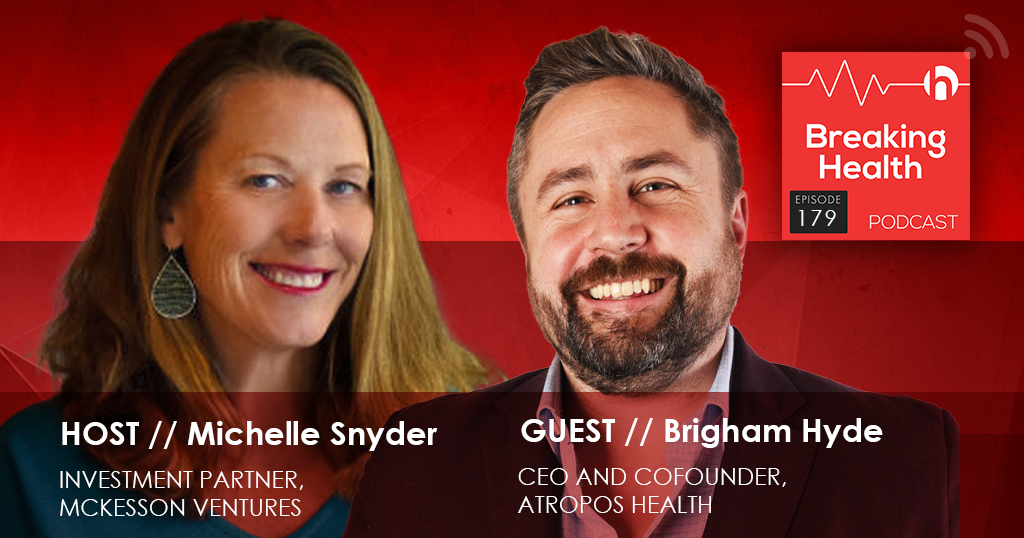
Brigham Hyde, CEO and cofounder of Atropos Health, joins Breaking Health to discuss his journey transitioning from clinical research to bridging the evidence gap—and how he and his team created more evidence than many others in the field. With host Michelle Snyder, their conversation explores impressive moves by big tech companies, the AI hype cycle (and how significant agentic AI is in healthcare), and what the industry talks about too much—and too little. Plus, an exciting announcement on what’s next for Atropos!
LINKS:
GUEST BIO
Brigham Hyde, CEO and Cofounder, Atropos Health
Dr. Brigham Hyde is CEO and co-founder of Atropos Health since August 2022. He provided funding and support for Atropos Health’s official launch in late 2020. Hyde has a significant track record of building businesses in the health tech and real-world data (RWD) space and most recently served as president of data and analytics at Eversana. Prior to that role, Hyde served as a healthcare partner at the AI venture fund Symphony AI, where he led the investment in, co-founded, and operated Concert AI, an oncology RWD company—most recently valued at $1.9B. Hyde held previous roles as chief data officer at Decision Resources Group, which was acquired by Clarivate for $900M in 2020. He has also served on the Global Data Science Advisory Board for Janssen, as a research faculty at MIT Media Lab, and served as adjunct faculty at Tufts Medical School.
HOST BIO
Michelle Snyder, Investment Partner, McKesson Ventures
Michelle is a partner at McKesson Ventures. The firm invests in venture and growth stage companies that build innovative software and tech-enabled services businesses for the healthcare and pharma industries. The Ventures team has deep healthcare investing and operating experience – and brings the expertise and connections of McKesson, one of the large healthcare companies in the world, to help portfolio companies succeed. Michelle ‘s investments include Atropos Health, Midi Health, RxVantage, Galileo, Lumata Health, and CancerIQ.
Before joining McKesson Ventures, Michelle spent over 20 years helping build digital health companies in chief marketing officer and GM roles, including building Epocrates into one of the most beloved physician technology products. Prior to McKesson, she worked in other operating, investing and consulting roles at Welltok, InterWest Partners, the Lewin Group and the Wilkerson Group. Michelle received her master’s degree from Kellogg School of Management and her bachelor’s degree from Carleton College. While she will always be a cheesehead from Wisconsin at heart, she calls the Bay Area home and enjoys hiking, paddleboarding, and traveling the globe finding new adventures with her husband and son.
TRANSCRIPT
Welcome to the Breaking Health Podcast, a series of discussions with the most important CEOs and leaders in digital health.
Michelle SnyderHi, everybody. This is Michelle Snyder, a partner of McKesson Ventures, and it's really great to be back hosting a new episode of Breaking Health Podcast. Today I am super excited to have Brigham Hyde, who's the CEO of Atropos on the show. And we're gonna spend some time talking both about the company as well as the evolution of AI over the past decade and where we think things go from here. And so with that, Brigham, welcome. Excited to have you.
Brigham HydeGreat to be here, Michelle. Thanks for having me.
Great. Well, before we jump in to learn more about the company, I always like to start with kind of the origin story and hear more about your journey. As I look back, mind your LinkedIn profile, you've worn many hats in your career. You've been a researcher, you've been an entrepreneur, you've been an investor. And when I look at your background, it almost seems like co-founding Atropos was almost inevitable. Like tell me about the journey and how you got to where you are.
Yeah, I promise it all makes sense somewhere in my head. No, I started out as a scientist, a bench and clinical researcher with a PhD in clinical pharmacology. I was in Boston at Tufts University in the 2000s and was incredibly inspired by the completion of the Human Genome Project and a lot of the early work being done around precision medicine. It also sort of felt like data might become important. And I found myself, after spending a couple of years in investment banking, wanting to build, and I've been doing that really ever since. And that's taken on different forms. But I like to think that the same curiosity that brought me to want to work in basic science, you know, at the time for me, it was about, you know, finding a cure for cancer and developing new drugs. You know, this sort of wave we've been in around AI and data is making that possible in a different way. It's not about just the basic science, it's also about uncovering cures and opportunities for patients from data and actually getting that evidence and information to them at the point of care where those decisions actually get made. So it's a big ecosystem. I've lived in many parts of it. And I think that experience informs a lot of what we do at Atropos. And in terms of it being inevitable, you know, it does combine a number of areas I've worked on, both, you know, applying AI technology and in healthcare, big data and real-world data, which I've been a major part of, that part of our industry. And what's exciting to me and remains exciting from when we started it is the idea of bringing that impact back to physicians and patients in an increasingly scaled way. And I'm as optimistic, I think, as I've ever been about the potential of precision medicine. It sort of feels like after saying precision medicine for 20 years, we may actually be close to doing it, which is really exciting and drives a lot of what we do here at Atropos every day.
Michelle SnyderGreat. All right. Well, then let's dig in on the company. Tell me a little bit more about, or tell the audience a little bit more about what the company does, why pharma and health systems care. Those are your two major customers, I believe, right now. And then I keep seeing a lot of in the press about the evidence gap. Would love to hear what the heck an evidence gap is.
Brigham HydeYeah, if you go through the experiences that I've had, I've been thinking about both developing new drugs, getting them approved to get them to market, but also, you know, the idea of precision medicine and trying to help people decide what therapy is right for them. I really met a kindred spirit in or two kindred spirits, my co-founders, Negum Shah, who's a chief data scientist at Stanford, and Sorb Gumbar is our chief medical officer. And we collectively are obsessed with that evidence gap concept, which the basic definition of it is just if you look at daily medical decisions, just decisions that get made every every day by doctors. Only about 14% of everyday medical decisions have high quality evidence behind them. And that's nobody's fault necessarily. You know, we been running clinical trials for, you know, a hundred years. You know, we've been doing observational research and studies, you know, for the last 50 or so. And we all want more studies and trials. It's just the reality that we haven't run enough. And when you add to that, you know, sort of the cost and incentive system around designing and running trials, as well as just, you know, the sheer effort and time it used to take to do it. And there's no surprise that we haven't run a study on every individual patient for every scenario. However, you know, we believe that by filling that gap, it actually solves a number of problems in healthcare. You know, one, it can be used to give physicians more confidence in their prescribing decisions. Two, if there is evidence, it's likely to lead to a better outcome. The more personalized, the better. And number three, I think even on the cost side, you know, if we're making sort of guideline level decisions across big populations, you know, I don't think it's a surprise that not everybody's gonna have the same outcome or the same impact on the cost of care for one set of rules. You really do need to enable personalization of that and fill that with new evidence. So if we're bought in on the problem, the way to solve it is what we've been focused on.
Brigham HydeAnd the three of us with our backgrounds, both on the clinical side, the data and AI side, and my experience building businesses around this, felt that what was needed was first automation. You have to be able to run these studies much, much faster. And you know, in other companies that I've run, concert AI, DOG, and others, I've I've been doing this type of work a long time, running observational research studies, rural data studies, but they typically took weeks and months to do. You needed big teams of programmers to do them, even if you had the data, and then the data itself could be problematic. So you had to shorten that gap. And if you couldn't shorten that gap down to even a couple days, it really wouldn't work at the point of care. You know, you've got a patient comes in, doctor sees them, they've got a day or two really to make a decision on what to do for that patient, and the patient's gone on to the next step of their care. So reducing that time to create a new study was goal one. And NIGAM had developed technology within Stanford called the green button. The idea was simple patient in front of you, you're not sure what to do. You go to the literature or guidelines, or today you might say Chat GPT or anthropic Claude. And you go there, you ask your question about that patient, and there's just no answer. Like there's no literature to be cited. You know, what do you do? And with the green button, you could send us the question. We would run a new observational study on patient data at the time on Stanford ZHR data, produce the output of that, including all the relevant statistical methods, and give you a direct answer with a statistical value to help make that decision. And within Stanford, they were running that in a couple of days, which was a dramatic leap forward, you know, even five years ago in speed. There's a lot of core tech and IP behind how they did that. And that's actually the formation story of Achro. We spun out that technology into the company Atropos and began developing on top of it. So, sort of step one was we need to automate the studies, but we need to make sure we do that at a really, really high quality level.
And so as we scaled to health systems initially and then to pharma, we continue to build that system out to be very transparent, auditable, traceable. We had things like data fitness scoring to ensure data quality. And ultimately, as we added generative tools, we also built the rails to make sure that you know you're asking a good question and that the results that came out could be trusted. One of the things we're proud of here is, you know, dozens of method publications over a decade, both within Stanford and without, that tell people exactly how we're doing what we do and making the output citable. The other thing we're happy about is over the years, you know, hundreds of these individual studies that have been run have gone on to be published. And we have a hundred percent peer review success rate when we do it. So it's fast, it's high quality. Okay, those are two good steps. We wanted then to think about how you could scale that. Now, one part of that is making it more available to people and physicians everywhere that they are, you know, things like EHR integration, nowadays ambient integration. We have a big partnership with Microsoft and Dragon Copilot for that. Also in Engentic forms that are coming. So we want people to be able to access this new evidence where it matters. And, you know, that's been underway for several years, and we have a huge footprint of reach of that. It also puts it in a place where they don't have to stop what they're doing and leave their workflow. They can just get it in flow. The last step to that, and the step we're at now, which is particularly exciting, and by the time this comes out, we either will have announced or are about to announce a major innovation from us, which is if you built this automation and you built tools where people can generate new evidence very quickly and you put it in workflow, the logical next step is to get on with it and fill the evidence gap. And we've actually turned our own automation on itself, and we'll be announcing that we've produced over 33 million new study equivalents over the last several months, and that's scaling to over 2 billion this year. And what am I talking about? If you think about 33 million, why is that number important or relevant? Well, PubMed itself has about 37 million studies total in it. And if you think about the source of evidence today, the evidence we do have, that's where it's being sourced from. And we're scaling to exceed and eclipse the scale of that evidence. One of the ways we're doing that is by running studies in known areas where that we lack evidence, or is like women's health, laid line oncology, pediatrics, geriatrics. There just aren't enough clinical trials out there, and they're not going to be. So these are areas that are obvious to fill. Other things that we're doing is creating sort of a cardinality to that approach where we can look at many different outcomes in many different subpopulations across many treatments. So, for instance, if we're asking, you know, GOP1 versus metformin, we can know the answer in a 45-year-old female Hispanic with CKD, what the evidence is for her, and what the evidence would be in that same question for a 55-year-old white male with arrhythmia.
Brigham HydeSo, in addition to scaling it, we are making it more personalized. And this has a new meaning now in the world of LLMs. You know, if you look at ChatGBT and others, they're all getting a ton of healthcare questions. And increasingly, they're asking you to upload your record into their platform so they can help add that context to the question. Well, if you upload your record to Chat GPT and you ask that GOP Metforman question, it's going to cite the same public trial that compared those drugs. It's not going to be able to factor your history into it without having new evidence to do it on. And so we, I'm sorry to see this library of evidence we produced is starting to become a really important novel training source for LLMs. And really, any patient or physician pacing LLM that you know has to answer these questions, you really need more evidence in order to answer them. There's a paper we put out called Answer with Evidence that actually measure this. We're the only one able to get to 100% answering these questions with the content we have. And it makes it an important training source for distribution. So our goal, very simply, fill the evidence gap. We've made a huge leap in doing that, not only with automation, but now with using that automation to create abundance, in this case, abundance of high quality evidence that's contextualized and personalized to every patient. So it's an exciting moment for us.
Michelle SnyderYeah, it's actually really exciting. And I did not, I mean, what you just said is pretty incredible. So in a few years' time, you basically have more, you've created more evidence than PubMed and all of the existing literature.
Brigham HydeIn all time, yeah.
Michelle SnyderIn all time. Well, I mean, is it because the technology is now here to let us do that? Or like, how were you able to do that in such a short amount of time?
Brigham HydeYeah, I mean, ultimately, there's obviously a lot of core automation technology that makes that possible. AI plays a role in a number of steps, both evaluating, you know, the quality and then also being able to produce that level of scale. Ultimately, there's now a lot of data available. We have the Atropos Evidence Network that contains over 894 million patient timelines across different data modalities. There's a lot of data available to actually run these studies in populations at size with our automation layer. And we've now sort of turned that on itself and begun to produce, you know, serial scale. And I would say, you know, one of the themes in this AI cycle is that we've expected AI to create abundance. And I think we're hitting that's that step. And for us, the abundance here is abundance of evidence. And at a time when we have a problem with this huge evidence gap, this abundance may help fill that. You know, if you think about the ultimate impact of this, it it if you have to take a step back from all these like AI buzzwords, like everybody in the world wants that studies with thousands of people just like them informing their care. That's what everybody wants. That's the promise of precision medicine. That's the promise of a learning healthcare system.
What I'm saying is it's now finally here. And where I think that abundance wave is hitting now is okay, so how do we have a system that can deal with that? Now, on the one hand, by integrating into workflow and feeding this up to doctors where they are. I trust doctors to be able to interpret evidence and decide what to do. And you know, when you're deciding for a patient, you should be able to look here's the guidelines and the trials, here's the personalized evidence for them and make a decision. They just didn't have that evidence before. And with it in their hands, especially with all the automation integration that now exists, I think they'll deal with that just fine. We are also going to need a precision medicine payment system. And that is the next wave that I think is coming, which is if you show somebody a study that says, look, clearly this GLP one is going to work for you, and the doctor agrees and prescribes it for you, well, what happens when the payer rejects it because of a policy based on a study done a decade and a half ago, right? And we need to follow that through into the payment system. But I would offer that, you know, not only having this evidence could enable payers to reduce the administrative burden of things like prior auth, but I think it's going to be a win for them too. Because it turns out if you have evidence and the patient does that better, they actually cost less, right? And we have early stats to back that up. It also makes intuitive sense. I sort of feel, and this is why Niggum and Sarb and I have been obsessed with the evidence gap. We're all fumbling around without evidence for what to do. And in lieu of that, you have a payment system that goes, wait a minute, why am I paying for this? There's no evidence it works. You have doctors going, well, I don't know. I saw a patient the other day who kind of looks like this. I'll follow that. We're all just feeling around the dark. If we all had this evidence, I think you could streamline the whole system. Yeah.
Michelle SnyderWell, I want to drill in on one of your customer segments a little bit, pharma, because I know you started off, or at least what I've read, you started off more on the health system side, but then there had been significant interest with pharma in what you were doing. And many times I talked to pharma executives. I mean, it sounds like they have a ton of data already, right? And they're buying all of this data. Now you're going to bring all of this new data. Is the is the issue that they had a lot of data, but they just didn't have the right data?
Brigham HydeYeah. I mean, pharma's been buying every piece of data we could come up with for, you know, the better part of 20, 30 years. Just speaking of, you know, us working with pharma, I mean, when we first went to them, the equation was simpler. These are the people that are the ones who create a lot of the evidence in the world, right? They're the ones who fund the clinical trials. They're the ones who run real world evidence studies and publish HUR studies. I mean, if you go back over the last 40 years, you could actually make a pretty clear case that, like, pharma's been producing most of the evidence we do have, right? And I would actually, I'm an advocate in this sense. I would argue if you look at the people who work in pharma, there are a lot of great talent there that understand how to do this well. They also have compliance frameworks that ensure this is done properly. They've been pretty good stewards overall. But I think what's starting to shift is they're realizing, you know, it can't just be one trial every two years. It can't just be one H E O R publication. Like they have a role to play in the knowledge space. And the way I would sort of describe this is if you think about all the data these companies buy, like what company in the world has more data about metabolic disease and diabetes than Eli Lilly? None. Okay. No big tech company, no social media, like Lilly knows.
Brigham HydeAnd they have the talent and they have the people there know how to do it. And my argument of late with them is they really need to think about unlocking that and unlocking it for the healthcare community, right? And, you know, if we think about what I've described, if I'm producing 33 million studies, why can't I help Lily make 33 million studies? Right. I mean, the same automation on the data they have. And I'm encouraging them, especially in, you know, the emerging agentic workflows where doctors are shifting where their eyes are going for information. You know, it used to be you would have your iPhone and you'd open up to date's app or something like that. And, you know, that's where you would go. And farm would find a way to advertise there, get their content there. Well, if all of a sudden they're just talking to an agent on their phone. Pharma really needs to be there, and they need to be there with something useful, useful being all this intelligence they know. And so we're encouraging to use our systems to reanalyze trial data and publish that, make it available through these agent workflows. In PharmaSpeak, this gets referred to as the agentic MSL. There's been a role, a human role in Pharma for a long time called the medical science liaison. They're not sales reps, right? But they're people who have access to the evidence information within the company and are relied upon by the clinical community as sort of colleagues, you know, when there are questions to discuss things. Well, in the digital and agent world, there should be an agentic front door to that. And I think this can all work through the appropriate compliance frameworks. One of the workflows we have is that our evidence agent, which is live right now in Microsoft Dragon Copilot and Microsoft Teams, you can download it today and you can actually ask questions and we'll answer them.
Brigham HydeThere's a sort of hook there where you could imagine bringing in the Eli Lilly agent if a question was asked about one of their products. And you could make it opt-in so that, you know, your doctor had to say, Yeah, I do want to talk to the Manjaro agent here. At that point, you know, you could have them answer with unique content, then the doctor would feel, okay, well, that feels like an MSL. That's the only place I can go to get this level of detailed information. I'm getting other things from Atropos and others, but you know, maybe there's a branding opportunity. So my point of encouragement to pharma brands is like start thinking about yourself as a knowledge brand, not just a product, because you know more about these patients than anybody else in the world. And you have an opportunity, if not maybe an obligation, to bring that information through. Good news is we can do it. I mean, there's a ton of scale to this now. The deployment hooks are there, the workflow is there. That's the exciting moment, I think, you know, around Gentech at the moment. Got it.
Michelle SnyderNo, very, I like that. The becoming you have the knowledge, be the knowledge brand.
AnnouncementAre you enjoying the conversation? We'd love to hear from you. Please subscribe to the podcast and give us a rating. It helps other people find and join the conversation. If you've got speaker or topic ideas, we'd love to hear those too. You can send them in a podcast review.
Michelle SnyderLet's talk a little bit about your experience, the all the experiences you've had leading up to Atropose, because this is not your first rodeo, I know. And you've, I'm sure, learned many lessons from precision medicine, concert DRG that you've probably applied now to Atropos. I would love to hear a little bit more about that. You know, in what in what areas are you repeating the playbook and you know, doing what worked before? And then, you know, are there some areas where you've learned from past mistakes, right? And you're applying those learnings now.
Brigham HydeYeah, I think there's a couple. You know, I I guess first and foremost, as an entrepreneur in healthcare, you you're trying to watch the technology cycles and what stage they're in, but then apply a healthcare lens. And when I say that, I mean, you know, there's systems of record and regulation and government payments. There's a lot of things there that maybe don't move quite as fast as the rest of you know the tech waves. So you kind of got to figure out where to put your board in the water. Like, don't be too early. You know, my first company was an AI drug discovery company that we founded back in 2011. That was too early, right? So, like we weren't ready yet. So, like, you got to figure out those parts and make sure you're you're getting the timing right. You know, I think the other part of that is figuring out what you're gonna stand out on. Because, in particular in this tech cycle, we all have these great tools now. It's very easy to start a company and and do something interesting that used to be very difficult. But, you know, how if you're doing something that is relatively easy to do and not unique and has standalone value, how long until a big chem tech company does it? I mean, that's something we always have to pay attention to.
Brigham HydeAnd, you know, I liken it to sort of picking a vector, you know. Like, okay, well, you know, where will Chat GPT be by this date or this date? And, you know, picking things that are hard for big tech companies to do that require very specific knowledge of use case and the setting. You know, in our case, this is producing evidence. It's really difficult to do and the difficult to do well. And so aiming all that power and technological innovation is something you can really own, I think is always a good idea. You know, another thing that just as an entrepreneur, like I'm very thoughtful at this point about who I involve in these companies, just from a capital perspective, raising more money always sounds great, but you really got to think about who you want as partners, both the individuals who made it up on your board, but also the entities themselves. You know, what are their motivations? And for one of the things I think we did right here is, you know, Atropos has a really big goal. We're just trying to fill the evidence gap. That's all, right? Like, and you know, how long is that going to take and how hard is that gonna be?
Brigham HydeSo you want to think about having groups that share that vision, understand why it's important, and you know, planning with them around what capital needs a business like that will require. You know, you always look for your big moment, of course, and you know, you always look for the moment to really strike and go big. But I think along the way, a mistake I see people make is, you know, going for headlines, going for splashy raises, and then putting themselves in a position where they really haven't found their moment and then it gets more challenging. So I having spent part of my life operating in private equity, I probably have more of a disciplined mind to that than than most. But I think in this cycle, it's gonna be really important. You know, you can start a company with three guys and a dog, right? So that's good because it sounds capital efficient, but you know, you also are gonna have faster cycles of these companies. So, how do you plan your own capital plan around that, making sure you've got enough to scale when it's right, but you're also not overcapitalizing.
Yeah, I could not agree with you more on that point for sure. I'm glad you brought up big tech because that was something I wanted to talk about, right? You and I have been in this industry for a long time. We've seen the ebbs and flows with big tech, you know, putting a lot of effort, coming in, pulling back, oftentimes with mixed success, right? And so I'd be curious from your perspective, is this the same movie we've seen before, or is something different here, right? And and maybe adding on to that, what moves by some of the big tech players have you been most impressed with?
Brigham HydeYeah, it's it's a really important question to think about. I think there's a couple of different big tech companies profiles at this point. There's sort of the group that grew out of cloud and infrastructure, you know, a little bit more on the Microsoft AWS side. Google, of course, part of Google is that way. And then there's the sort of I would almost call it consumer-facing tech companies, OpenAI maybe being sort of the a pure play there initially. You know, you have X or Grok, you've got Meta, you've got, you know, a number Anthropic is this way too, in a sense. So, you know, I think the two groups are slightly different. To take the LLM group, the more consumer-facing group, I think what's different this time is like they, and you could tell by the stats, I think OpenAI has published a number of these, they're getting a ton of healthcare questions, right? And if you think about their businesses, they have to serve those consumers, right? And whether those are doctors or their patients, they cannot ignore that.
Brigham HydeAnd I think that is different because this means this time, like they've actually got to figure out something to service those users, or they risk losing to their competitors that volume of engagement and interest, which is largely how those businesses run. So I think it's a an imperative for them in that sense. I think they'll take different approaches to it. Some will, you know, go very patient focused and try and build out vertical businesses around that. Some may provide tools and, you know, have partnerships to do it with. I think when you talk about the cloud guys and, you know, sort of the AWS, Microsoft, Google, I include Oracle here, and you can maybe include Epic from a health tech pure play perspective. You know, these guys have really got to build from the infrastructure layer that they're a big part of, the system of record, the storage, the architecture layer, into gaining the value of, you know, the actual completing the job for their B2B clients and being the application layer. That that's what we're seeing from them. They're all doing it slightly differently and slightly different strategies. My sense is that Microsoft is playing a great hand at the moment in this sense.
Brigham HydeTheir partnership with Epic was very notable to us. I think understanding that they really wanted to own the agentic workflow, they wanted to take their footprint on the cloud storage side. I was thinking it's probably wise for Epic to do that partnership because it's not good news for Oracle to have those two teamed up. So, you know, I watched the big chess moves with the popcorn like everybody else. You know, I think those things are smart. You know, AWS is a major player, you know, particularly in life sciences and healthcare and has great tooling and sets. I see them getting more close with anthropic every day in that setting. And, you know, given that they don't have a native LLM themselves, I think that's probably also wise. So, you know, you have to watch these alignments. I mean, who who wins in the end? I tough to say. I mean, you know, I think there'll be many winners in healthcare, but you have to watch those movements. The LLM and consumer patient-facing people have to serve those users. That's different. And there's a big imperative of the cloud infrastructure guys to move into the application layer.
Brigham HydeWhether they get all the way there is a question for us. You know, we still believe that, you know, there's enough verticalization and knowledge, and especially in key areas where there's plenty of room for startups to play, you know, and I've continued to back many of them as well. You know, I think you have to also assume, though, they're gonna do the high volume, easy things pretty well. You know, like if you're writing prior auth letters, I have a feeling somebody's gonna figure out how to get an LM to do that from a big tech company. You know, if you're if you're doing billing, you know, why can't they figure it out? So you have to think about those things. I don't know that I'm right about any of those, but those are things that I think about when I'm looking at it.
Michelle SnyderRight. Thank you. So, in as I was prepping for our time together, I did the bring them way back machine and went back and listened to a few podcasts you had done maybe a decade or so ago. One I thought, well, there were two that were interesting. One that was particularly interesting was I think it was in 2018, and you were talking about that we were in the middle of this AI hype cycle, which then I thought was a bit ironic because today I feel like we are in a bit of an AI hype cycle. And so what I want to hear from you is do you think we're in another AI hype cycle now, or is there something fundamentally different about today? And maybe really the question is, you know, how big of a deal is agentic AI and healthcare? Since that's what we're all talking about right now.
Brigham HydeYeah, I think the podcast you're referring to was when I was at concert AI and we were discussing the early days of the AI bubble. I mean, this is we formed Symphony AI, which led the investment in that in 2016. So very early in that hype cycle. These cycles sort of overlap and loop off of each other. You know, at that, at that point, there was zero distribution, right? And there wasn't a lot of scale and automation in what AI could even be. You know, I think a lot of it was still laying the the underpinnings at that point and then finding the point solutions that could work. So we went through that cycle. You know, as as we've gotten onto this cycle, I do think we are in the midst of the agentic cycle. And I think I'm actually pretty enthusiastic about it. I I don't know that we know the form it will take, but I do think that the user experience is shifting to it. Does that mean there's one agent through them all? Does that mean we have juries of agents and model protocols that talk back and forth? How the economic, how do you create a winner in that environment?
Brigham HydeYou know, is there going to be like 10 key agents that do 10 key things? I it's a little bit uncertain at this point. Although I do think, you know, as the workflows shift and as the attention of, in particular, clinicians shift, I do think it's it's something worth tacking to. And we we certainly have. You know, my ultimate view on all of that is like the real value will be derived by the agents that do something really unique, right? Big tech will get their piece of the rest, right? So from a startup perspective, our evidence agent is the only agent available right now. It's actually, you know, live in in Dragon Co Pilot and Teams that can actually generate new evidence and personalize it to a patient. And what's particularly exciting to me is that, you know, it takes it from an experience where you had to go out and ask a question and maybe something that's just happening in the background. You know, right now when an ambient visit is being recorded, actually pings our agent in the background, the agent determines what the key questions are, answers them both with literature-based, guideline-based evidence, and novel evidence, and certs it right in epic as the doctor swivels their chair over to read the note. So, like this type of passive automation, integrated automation is a good test because like they always say any good automation becomes invisible, right? So, like, you want to just be something that's there. We we had a great quote, primary care doc at Stanford, Dr. Schenkman was in our last announcement.
He said, It's as if Atropos is reading my mind. Like, you know, he comes in the morning, he's got his pre-visit summaries, there's evidence loaded in there already, and we're telling him the things he should be thinking about, and then giving him evidence personalized to each patient. And just from a user experience, like that's what people want, right? They don't want to have to like go find a login to another, like that's what they want. They want it right there, they want exactly what they want it where they want it. So I think agentic in that sense still has a lot of potential. You know, is every agent business going to win? Is every agentic platform gonna scale? Probably not, right? But I think you know, a few will. That's what we hope.
Michelle SnyderI mean, the this question might tie into my next question and be one of the things we're talking too much or too little about a bit about, but you you speak a lot, and and that's partially why I wanted to have you on the show, is you you really are kind of a thought leader in this space on evidence, but also just on AI in general. And you know, you were at hymns and other events, and so you hear a lot of speeches too. What do you think we're talking about too much as an industry that we shouldn't spend that much time talking about? And maybe on the flip side, what are we not talking about that we should be talking about as an industry?
Brigham HydeYeah, I mean a year ago I would have said we were talking way too much about safety. Like, you know, everybody loves the scary headline of the hallucination, but you could just see the direction and the vector of evolution that these models were on. Like they're getting better every day. We just have to assume that. You know, I think this year, one of the things that Negum and I have been talking a lot about is like our measurement of the impact of these things is terrible right now, right? And you know, with the rise of ambient scribes, there was a huge focused on time savings. Well, when it comes down to it, I mean, Nickum has stronger opinions than I do, but like I don't just think we're gonna see a nickel saved or a dollar revenue gained by a lot of the automation that's rolled in yet. And his point when we talk about this is just I think we're looking at the wrong thing, right? Like, and this gets to like a broader topic that I don't love now, which is like job replacement. It's like, well, maybe the way to think about this is we're not trying to, you know, have doctors see one more patient, and that's the measure, or replace some staff worker with a fully automated workflow. Like maybe we should be thinking about how to use AI to like shape bigger elements of this. And I'm talking about like truly transformative change. Like I've referred to prior auth before. Like, what if prior auth was gone, right? Like, what if we could do something like that? And what would be the impact not only on reimbursement levels and things like that, but also just the cost the system has of doing things the way they do it now, you know?
Brigham HydeSo like I think the big transformative ideas and how we should measure them haven't really been thought through. One one call out I'll make for Nickum, he and his colleagues at at Stanford have released something called Chat EHR, which is an LM interface, you know, to the systems within Stanford, namely the EHR. One of the things they found was like, yeah, doctors like talking to it. That's great. But that's not where the ROI was, right? It wasn't in saving two minutes summarizing a chart. It was actually in administrative tasks they could set up, deploy, and test, and then monitor over time things like, you know, looking at inpatient stays and bed rotation and, you know, different ways to optimize, you know, who bed occupancy. And these are like for the business of healthcare, these are the types of things that are really going to bend the the curve. I think the experiential side is interesting and exciting and you know, a new experience, but I think the metrics are off right now in the way we're looking at this. Like it shouldn't be burnout, shouldn't be time savings, it shouldn't be seeing more patients. It should be ways to cut out what we all know is waste and healthcare with these techniques.
Michelle SnyderWell, I am sure there are many people that would vote for prior off to be gone, or at least to figure out a better way to do prior off to save everybody time and hassle and make the patient experience a lot better. I have one final question for you. What's next for the company? Are there any exciting announcements or partnerships you can leave with us, or or even just thinking about what you're going to be focusing on in the next year?
Brigham HydeYeah, and I've referred to the announcement we, by the time this comes out, will have made or will be making, but the the 33 million study equivalents going to over 2 billion this year, really trying to solve this evidence gap. We're labeling it as evidence everywhere for everyone. And those words are really chosen carefully. You know, evidence refers to the method and the quality of what we're producing. You know, every everywhere refers to where it's going to be. And we're going to announce a series of partners on the workflow side, in addition to Microsoft, which we've already announced, that we'll put this in workflow for physicians. No logging into an app to go get something else. This is going to be at your fingertips. And for everyone, really refers to a couple of things. You know, one, one of the things we're filling this evidence gap are the underrepresented patients, right? And there's obviously certain groups that I've referred to women's health, the elderly, the young, pregnant women.
Brigham HydeYou know, they're just classically underrepresented in evidence, but I'm also talking about the complex comorbid, which turns out to be most of the patients. This group is systematically excluded from clinical trials, and it has always been for a variety of reasons, but they're most of the patients. I also think of this potentially as international. So this is about representation, it's about having evidence for you so that you can have the best medical decision made, you know, for your care. And, you know, the other part of everyone is we want this to be available to everyone, like every doctor and eventually every patient in the forms they're used to consuming it. So again, these partnerships will elucidate a lot of that. And, you know, we're excited to scale it from here. I think ultimately what we're really talking about is the true dawn of precision medicine. It's going to need a precision payment system, it's going to need precision tools back to patients, but we think it's now possible because you have the evidence. If you didn't have the evidence, you couldn't answer these questions, you couldn't make these changes, you couldn't have precision care. We have the evidence now. So it's incredibly exciting to be at this moment and excited to see where it goes.
Michelle SnyderYeah, I am too. No, I mean that's the holy grail, right? Honestly, evidence everywhere for everyone. I love it. I can't wait to hear more about it. So thank you so much for joining us today, Brigham. Really appreciated having you on the show.
Brigham HydeThanks so much, Michelle.
Michelle SnyderBye-bye. And thank you, everyone, for listening to this episode of the Breaking Health Podcast. We'll see you soon.
Do You Have
A STORY TO TELL?

If you’d like to be considered as a guest on a future episode of the Breaking Health podcast, please complete the application today.
Meet Our Hosts

Payal Agrawal Divakaran, .406 Ventures
Steve Krupa, HealthEdge
Michelle Snyder, McKesson Ventures
Subscribe ON iTUNES

Don't miss an episode. Join the conversation by visiting our podcast channel on iTunes today and subscribe. It's fast and free!

 SUBSCRIBE ON iTUNES